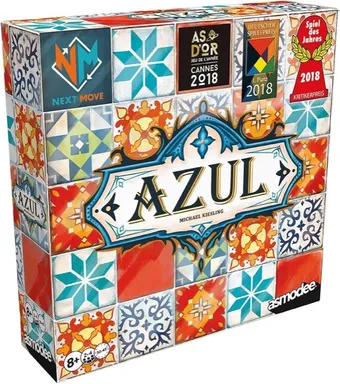
Azul in 60 seconds
Draft colored Portuguese azulejo tiles from shared factory plates onto your five pattern rows. Once all tiles are drafted, completed rows transfer one tile to your mosaic wall for adjacency points — while overflow tiles crash onto your floor for negative points.
- Goal
- The game ends after the round in which any player finishes at least one complete horizontal row of 5 tiles on their Wall. Add end-game bonuses (+2 per full row, +7 per full column, +10 per complete color of 5 tiles).
- On your turn
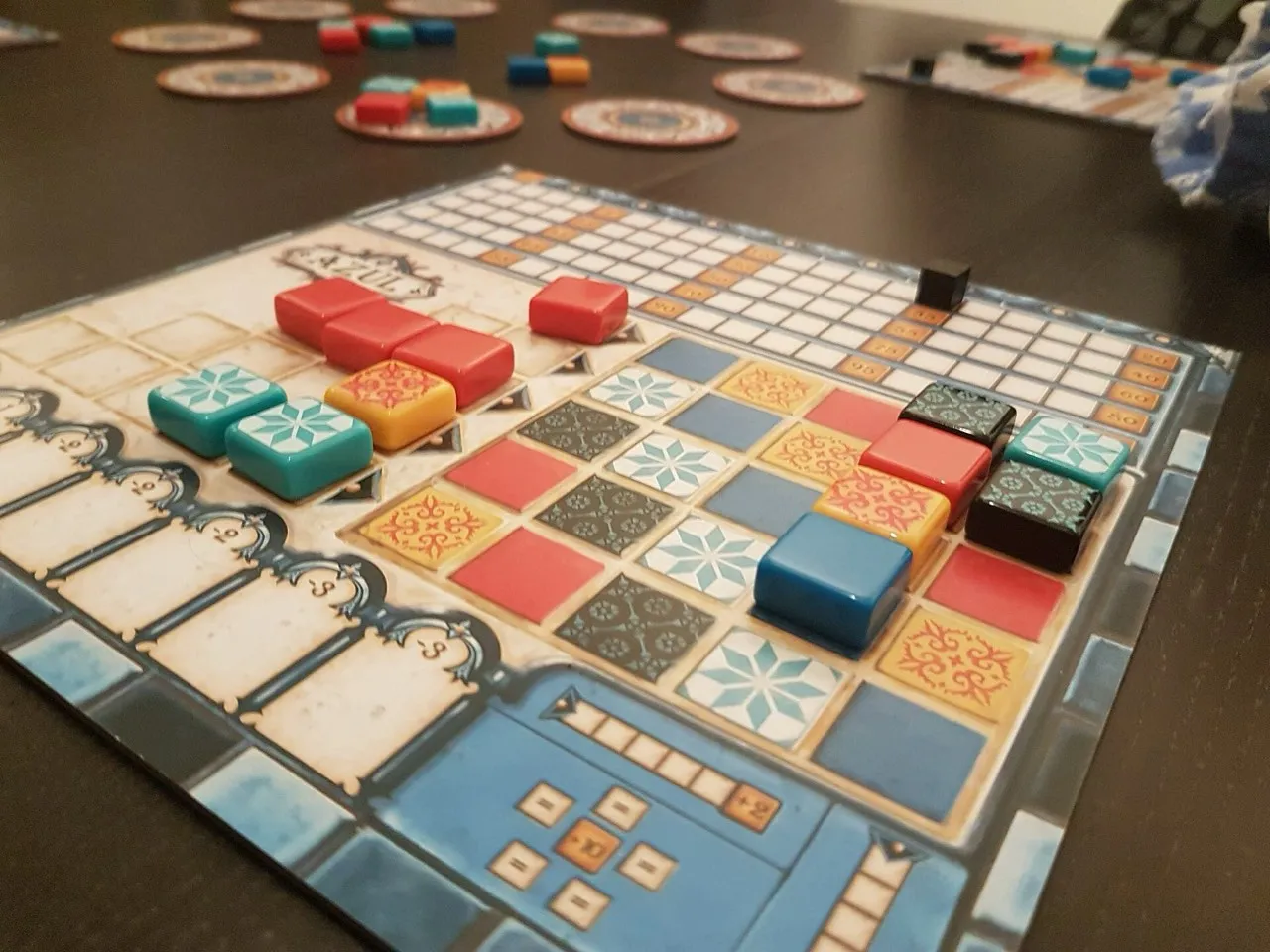
- 3 steps, explained with a diagram below.
- Core mechanics
- Tile Drafting · Pattern Building · Set Collection · Abstract Strategy
How to set up Azul
- Place Factory Display coasters in the center: 5 for 2 players, 7 for 3 players, or 9 for 4 players.
- Put all 100 resin tiles into the linen bag and place 4 random tiles onto each Factory Display.
- Give each player a player board (colored side up) with their black scoring cube on 0.
- Place the white '1' First Player tile in the center of the table.
How a turn works in Azul
Every turn in Azul follows the same 3 steps. The diagram shows how they fit together on the table.
- Pick ALL tiles of ONE color from either a single Factory Display (pushing leftover tiles to the center) OR from the center pool.
- Place every drafted tile onto one empty or same-colored pattern row on the left side of your board; excess tiles spill onto your Floor Line for negative points.
- When all factories and the center are empty, move the rightmost tile of each FULL pattern row onto your Wall, scoring horizontal + vertical chains, and subtract Floor Line penalties.
How to win Azul
The game ends after the round in which any player finishes at least one complete horizontal row of 5 tiles on their Wall. Add end-game bonuses (+2 per full row, +7 per full column, +10 per complete color of 5 tiles).
Watch: how to play Azul (video)

Video by Good Time Society on YouTube. Independent creator content, shown as a reference. It is not part of our scoring.
Azul rules people often get wrong
- Placing a color into a pattern row when that color already exists on the corresponding horizontal Wall row (illegal — those tiles must go straight to the Floor Line).
- Clearing unfinished pattern rows at the end of a round — incomplete rows STAY on your board for the next round!
- Scoring a newly placed Wall tile only once when it connects both horizontally and vertically (if it touches neighbors on BOTH axes, count the tile itself in both chains).
Azul strategy tips for beginners
- Aim for vertical columns (+7 points) and full 5-of-a-color sets (+10 points) — they decide almost every close game.
- Build toward the center columns of your wall first so future placements trigger big horizontal AND vertical combo chains.
- Taking the '-1' First Player marker is often a bargain if it lets you grab a 3-tile stack or force an opponent into a -8 floor penalty.
- Count how many tiles of a needed color remain on the table before committing to the 4- or 5-space bottom rows.
Is Azul right for your group?
Azul is modern abstract perfection. Anyone can grasp its tile-drafting rule in two minutes, yet every single pick creates a delicious push-and-pull between building your own mosaic and leaving awkward scraps for the next player.
Best for: 2–4 players seeking a fast, tactile, gorgeous puzzle with surprising competitive bite.
You'll love it if…
- Chunky resin tiles clack together with unmatched tabletop feel
- Teaches in 3 minutes — zero text on components, completely language-independent
- Plays equally brilliantly as a tight 2-player duel or breezy 4-player family game
- 30-minute runtime makes 'let's play one more' almost guaranteed
Think twice if…
- Can get surprisingly cutthroat at 2 players when forcing rivals to take floor penalties
- Cardboard score marker cubes slide easily if the table gets bumped (overlays help)
- Abstract theme has minimal story immersion compared to Wingspan or Everdell
Which Azul edition & expansions to buy
Start with the base game. Only add an expansion once Azul is hitting the table regularly.
 Start HereAzul (Original Base Game)The purest, tightest version in the Azul family and the easiest to teach to anyone.$30–$40Check price
- Best SequelAzul: Summer PavilionSlightly deeper star-mosaic version with wild colors each round and far less punishing floor penalties.$34–$44Check price
- Best Accessory UpgradeAzul: Crystal Mosaic ExpansionAdds plastic board overlays that lock your tiles and score marker in place, plus double-sided alternate boards.$16–$22Check price
Prices are typical street prices and change often. As an Amazon Associate we earn from qualifying purchases.
What Azul feels like at the table
Few board games hook people purely through touch the way Azul does. Scooping glossy, heavyweight resin tiles out of a linen bag and clicking them onto your mosaic wall feels timeless — and underneath that bright Portuguese art sits a delightfully sharp tactical contest where every tile you leave behind becomes a trap or a gift for the next player.
Player-count sweet spot
Two players turns Azul into tactical chess with zero downtime (~25 minutes). Three and four players bring looser, livelier drafting energy where you react more to the changing center pool than perfect tile counting — great for family nights and mixed groups.
Buying & expansion path
Pick up the original Azul first — it regularly sits around $30–$40 and earns a spot on virtually every starter shelf. If you fall in love with tactile spatial puzzles, pair it with Cascadia and Harmonies, or check our best 2-player board games guide.
Azul rules FAQ
How many players can play Azul?
How long does Azul take to play?
How do you win Azul?
Is Azul hard to learn?
What age is Azul for?
Which Azul game is the best one to buy first?
Is Azul good for 2 players?
Do I need the Crystal Mosaic expansion?
Official rules & more Azul resources
- Next Move Games Official Azul Page ↗Official RulesOfficial publisher site with downloadable rules and Azul family editions.
- Azul on BoardGameGeek ↗Database & ForumsWall-scoring edge cases, 2-player strategy discussions, and sequel comparisons.
- Azul on Board Game Arena ↗Play OnlineFastest place to play crisp 10-minute 2P or 4P Azul matches online.
- UltraBoardGames Azul Guide ↗Strategy & WikiStep-by-step illustrated wall scoring examples and end-game bonus breakdown.
Sources: nextmovegames.com · boardgamegeek.com
Azul also appears in: Board Game Mechanics Explained: Engine Building, Worker Placement, Drafting & More · Best Gateway Board Games for Beginners & Family Game Night (2026) · Best 2-Player Board Games (2026): Duels, Co-ops & Date-Night Picks