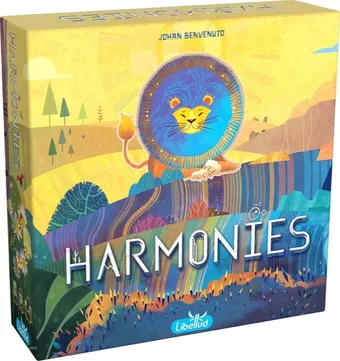
Harmonies in 60 seconds
Draft sets of 3 wooden landscape discs and stack them on your personal hex grid to build mountains, tall trees, rivers, fields, and buildings — recreating the exact 3D micro-habitats shown on your Animal Cards to populate your miniature world.
- Goal
- The game ends when the token bag runs out or any player has 2 or fewer empty hexes remaining on their board. Score all 5 landscape types plus the highest uncovered number on every Animal Card.
- On your turn
- 3 steps, explained with a diagram below.
- Core mechanics
- 3D Tile Stacking · Pattern Building · Open Drafting
How to set up Harmonies
- Place the central board and draw 3 random wooden tokens from the cloth bag onto each of the 5 circular spaces.
- Deal 5 Animal Cards face up in a row next to the central board.
- Give each player a double-sided landscape board (Side A for your first game) and a player aid card.
How a turn works in Harmonies
Every turn in Harmonies follows the same 3 steps. The diagram shows how they fit together on the table.
- Mandatory: Pick ALL 3 wooden tokens from one of the 5 central spaces and place each on your board (stacking trunks under leaves, gray rocks into tall mountains, or bricks into buildings).
- Optional: Take 1 face-up Animal Card into your active row (maximum 4 unfinished Animal Cards at a time).
- Optional: Whenever your board matches an Animal Card's exact layout, move a wooden Animal Cube from the card onto the indicated hex.
How to win Harmonies
The game ends when the token bag runs out or any player has 2 or fewer empty hexes remaining on their board. Score all 5 landscape types plus the highest uncovered number on every Animal Card.
Watch: how to play Harmonies (video)

Video by Watch It Played on YouTube. Independent creator content, shown as a reference. It is not part of our scoring.
Harmonies rules people often get wrong
- Stacking a brown trunk on top of green leaves, or trying to stack onto a blue Water or yellow Field hex (water and fields must stay 1-high).
- Ignoring the rule that Mountains ONLY score if they touch at least one other Mountain.
- Placing an Animal Cube on a hex and later trying to build taller on that same hex — animal cubes permanently cap that stack.
Harmonies strategy tips for beginners
- Overlap your Animal Cards! Pick two or three animals that share a River or Tree cluster so one single habitat triggers multiple cubes.
- Don't neglect Landscape scoring — a 6-hex winding River and two pairs of yellow Fields can quietly score 30+ points on their own.
- Build Buildings (red roofs over gray/brown/red bases) right in the center of your board where they touch 3+ different surrounding colors for 5 points each.
- Watch your empty spaces! Ending the game cleanly before rivals finish their high-value 3-cube Animal Cards is a lethal strategic weapon.
Is Harmonies right for your group?
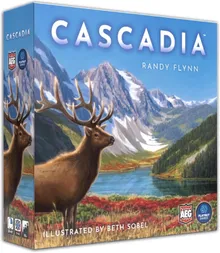
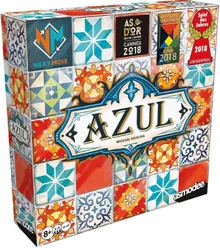
Harmonies is the standout gateway hit of 2024–2026. If Azul and Cascadia had a gorgeous 3D wooden child, this would be it — effortless to learn, deeply satisfying to touch, and surprisingly crunchy to optimize.
Best for: Fans of Azul and Cascadia who want a tactile, 3D spatial puzzle with gorgeous storybook art.
You'll love it if…
- Stacking colored wooden discs into 3D mountains, trees, and brick buildings feels magical
- Tight spatial tension — your board fills fast and every placement pulls double duty
- Plays in 30 minutes with almost zero setup and a clean solo mode
- Two distinct board sides (River vs. Island) plus Nature Spirits add longevity
Think twice if…
- Can cause minor analysis paralysis when trying to fit 3–4 animal patterns simultaneously
- Strictly multiplayer solitaire aside from drafting the 5 shared token trios
- No expansion yet (though the base box has plenty of animal variety)
Which Harmonies edition & expansions to buy
Start with the base game. Only add an expansion once Harmonies is hitting the table regularly.
 Start HereHarmonies Base GameComplete 1–4 player box with 120 colored wooden discs, cloth bag, 32 animal cards, and 10 Nature Spirits.$32–$40Check price
- Best Table UpgradeBoard Game Token Trays (Silicone Bowls)Keeps Animal Cubes and spare discs tidy and speeds up setup for Harmonies and similar tile games.$12–$18Check price
Prices are typical street prices and change often. As an Amazon Associate we earn from qualifying purchases.
What Harmonies feels like at the table
Harmonies is a feast for both your hands and your eyes. Stacking smooth wooden discs into two-story stone peaks, tall green-topped oaks, and bustling red-roofed villages turns your personal hex board into a miniature 3D diorama — while every space that fills up tightens the puzzle of where your last three animals can possibly fit.
Player-count sweet spot
Two and three players hit the crispiest rhythm (~30 minutes) with zero wait between drafting turns. Four players plays smoothly in 45 minutes and makes the shared display of 5 Animal Cards turn over rapidly.
Buying & expansion path
Pick up Harmonies as a standout 2024–2026 gateway jewel. If your group adores tactile spatial puzzles, pair it with Cascadia and Azul — or browse all breakout titles in our fastest-growing board games guide.
Harmonies rules FAQ
How many players can play Harmonies?
How long does Harmonies take to play?
How do you win Harmonies?
Is Harmonies hard to learn?
What age is Harmonies for?
Is Harmonies harder than Azul or Cascadia?
Does Harmonies include a solo mode?
When should we add the Nature Spirit cards?
Official rules & more Harmonies resources
- Libellud Official Harmonies Page ↗Official RulesOfficial rulebook PDF, Nature Spirits guide, and solo scoring benchmarks.
- Harmonies on BoardGameGeek ↗Database & ForumsHigh-score strategies, Building adjacency clarifications, and Side B tips.
- Harmonies on Board Game Arena ↗Play OnlinePlay quick 15-minute online games with full 3D visual board stacks.
Sources: libellud.com · boardgamegeek.com
Harmonies also appears in: Fastest-Growing Board Games Right Now (2024–2026 Breakout Hits)