Splendor in 60 seconds
Collect poker-chip gems to purchase Renaissance mine, transport, and shop cards. Every card you buy grants a permanent gem discount toward future cards — and many also carry prestige points or attract high-value Noble patrons.
- Goal
- Once any player reaches 15 prestige points, finish the current round so everyone gets equal turns. Highest score wins (tie-breaker: fewest purchased cards).
- On your turn
- 3 steps, explained with a diagram below.
- Core mechanics
- Engine Building · Open Drafting · Set Collection
How to set up Splendor
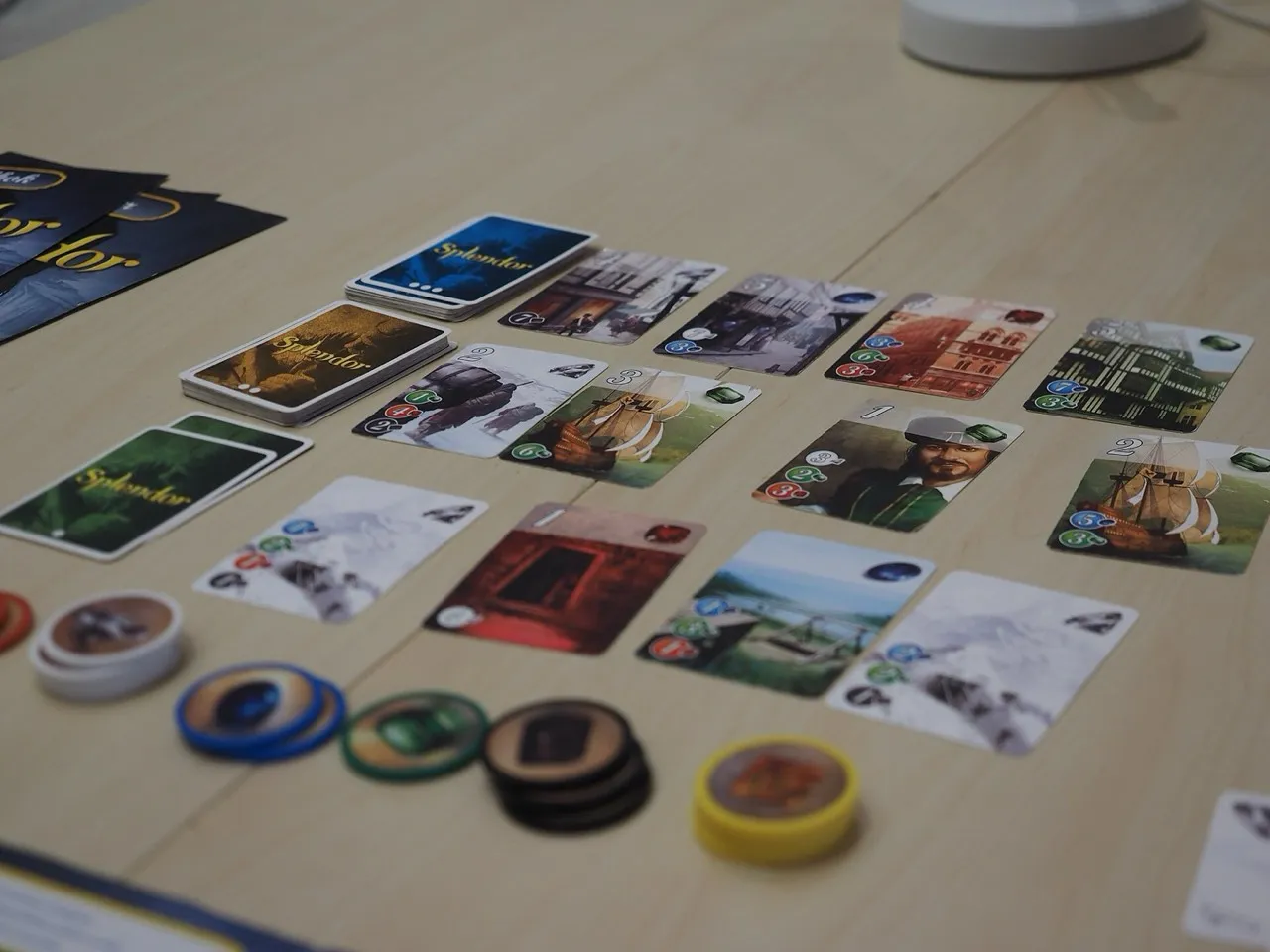
- Adjust the 5 colored gem stacks to match player count: 4 each (2P), 5 each (3P), or 7 each (4P), plus all 5 Gold wild chips.
- Shuffle the Level 1, Level 2, and Level 3 development decks separately and deal 4 face-up cards from each tier.
- Reveal Noble tiles equal to the number of players plus 1 across the top row.
How a turn works in Splendor
Every turn in Splendor follows the same 3 steps. The diagram shows how they fit together on the table.
- Take ONE action: Take 3 different colored gem chips OR take 2 identical gem chips (only if at least 4 of that color remain in the supply).
- OR Reserve 1 card into your private hand (max 3 reserved) and take 1 Gold wild chip.
- OR Buy 1 face-up or reserved card using your permanent card discounts plus gem chips, then check if your cards automatically attract a Noble (+3 points).
How to win Splendor
Once any player reaches 15 prestige points, finish the current round so everyone gets equal turns. Highest score wins (tie-breaker: fewest purchased cards).
Watch: how to play Splendor (video)

Video by Watch It Played on YouTube. Independent creator content, shown as a reference. It is not part of our scoring.
Splendor rules people often get wrong
- Using Gold chips or colored chips to qualify for a Noble — Nobles ONLY count permanent gem bonuses printed on purchased cards.
- Forgetting the 10-chip hand limit (if you take chips that push you over 10, you must immediately return down to 10).
- Taking 2 of the same color when only 3 chips are left in the stack — 4 must be present BEFORE you take them.
Splendor strategy tips for beginners
- Splendor is a sprint to 15 points, not a slow engine-builder: shift from buying cheap 0-point Level 1 cards to reserving 2–4 point Level 2/3 cards earlier than you think.
- Use the Reserve action offensively! Grabbing a key card your opponent is saving for gives you a Gold wild chip AND ruins their next two turns.
- Look for two Nobles that share overlapping gem requirements so one color engine scores 6 free bonus points.
- Track which chip color is running dry in 2–3 player games — hoarding a scarce color can lock opponents out for turns.
Is Splendor right for your group?
Splendor distills engine-building down to its cleanest, most tactile essence. Stacking heavy gem chips to buy permanent discounts feels deeply gratifying, and its 30-minute runtime makes it one of the most replayed shelf staples in tabletop gaming.
Best for: Players who love sleek, zero-fluff engine building, tactile poker chips, and brisk 30-minute rematches.
You'll love it if…
- Weighted clay-style gem poker chips feel fantastic to stack and spend
- Crystal-clear rules: explain the whole game in 3 minutes flat
- Addictive snowball loop where cards eventually make later cards completely free
- Minimal table space and almost instant setup
Think twice if…
- Theme is purely decorative — feels like a pure math & race puzzle
- Very quiet table talk compared to trading or party games
- For strict 2-player play, Splendor Duel is even tighter than the original
Which Splendor edition & expansions to buy
Start with the base game. Only add an expansion once Splendor is hitting the table regularly.
 Start HereSplendor (Refreshed Edition)Classic 2–4 player gem-drafting engine builder with heavy poker-style gem tokens.$32–$42Check price
- Best for 2 PlayersSplendor DuelStandalone 2-player redesign with a 5×5 gem drafting grid, pearls, privilege scrolls, and 3 win conditions.$24–$30Check price
- Best ExpansionSplendor: Cities of Splendor ExpansionFour modular mini-expansions (Trading Posts, Cities, Orient, Strongholds) that add rich variety.$32–$40Check price
Prices are typical street prices and change often. As an Amazon Associate we earn from qualifying purchases.
What Splendor feels like at the table
Splendor is the espresso shot of engine-building games. There is zero clutter, zero text to read on cards, and zero tedious upkeep. Clacking heavy gem poker chips into neat stacks and watching your permanent discounts grow until high-tier Renaissance mines become free is endlessly gratifying.
Player-count sweet spot
Three players hits the sharpest balance between chip scarcity and open planning. Four players increases market churn (making reserving cards essential), while two players is razor-tight and finishes in 20 minutes.
Buying & expansion path
Grab Splendor for a 2–4 player shelf staple, or go straight to Splendor Duel if you primarily game as a couple. Ready to expand your engine-building tastes? Step up to Wingspan or Forest Shuffle, or explore our board game mechanics explainer.
Splendor rules FAQ
How many players can play Splendor?
How long does Splendor take to play?
How do you win Splendor?
Is Splendor hard to learn?
What age is Splendor for?
Should I buy Splendor or Splendor Duel?
How long does a game of Splendor actually take?
Does Splendor have much player interaction?
Official rules & more Splendor resources
- Space Cowboys Official Splendor Page ↗Official RulesOfficial rulebook PDF and overview of Cities of Splendor and Splendor Duel.
- Splendor on BoardGameGeek ↗Database & ForumsCompetitive opening theory, tie-breaker clarifications, and variant guides.
- Splendor on Board Game Arena ↗Play OnlinePlay brisk 15-minute online matches against ranked opponents worldwide.
- UltraBoardGames Splendor Rules ↗Strategy & WikiQuick-reference turn guide and player-count gem chip setup chart.
Sources: spacecowboys.fr · boardgamegeek.com