Mahjong in 60 seconds
Players take turns drawing a tile from the wall or discard pile, then discarding one tile to maintain a 14-tile hand. The goal is to form four sets (sequences, triplets, or quads) plus one pair before anyone else. Calling 'Mahjong!' ends the round when you complete a winning hand.
- Goal
- First player to form a complete hand of four sets plus one pair calls 'Mahjong!' and wins the round. Scoring varies by variant: Chinese uses faan points, American uses the annual NMJL card, and Japanese Riichi uses a complex yaku system.
- On your turn
- 3 steps, explained with a diagram below.
- Core mechanics
- Set Collection · Hand Management · Pattern Building · Rummy-style Matching
How to set up Mahjong
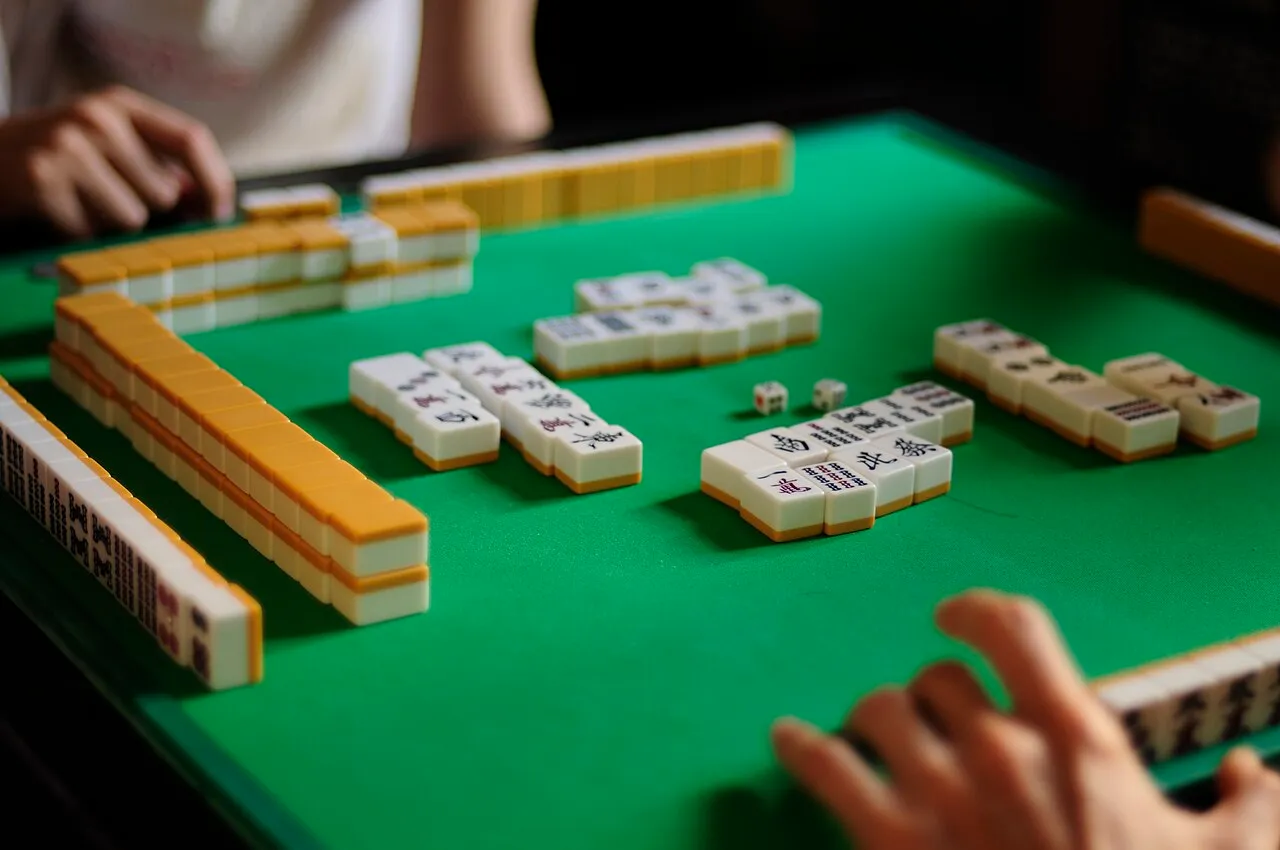
- Shuffle all tiles face-down and build a wall two tiles high and as long as the table allows (typically 17-18 tiles per side for Chinese play).
- Each player rolls dice to determine seating positions and who deals first (East wind).
- Deal 13 tiles to each player in clockwise order, then draw a 14th tile to start.
- Place remaining tiles as the draw pile (the 'wall') in the center.
How a turn works in Mahjong
Every turn in Mahjong follows the same 3 steps. The diagram shows how they fit together on the table.
- Draw one tile from the wall (or claim the previous player's discard to complete a set).
- Optionally declare a pung (three matching tiles), kong (four matching tiles), or chow (three consecutive tiles in the same suit) using discards.
- Discard one tile face-up to the center, keeping your hand at 13 tiles (14 only when you've won).
How to win Mahjong
First player to form a complete hand of four sets plus one pair calls 'Mahjong!' and wins the round. Scoring varies by variant: Chinese uses faan points, American uses the annual NMJL card, and Japanese Riichi uses a complex yaku system.
Watch: how to play Mahjong (video)
Video by Alpaca Alix on YouTube. Independent creator content, shown as a reference. It is not part of our scoring.
Mahjong rules people often get wrong
- Forgetting to declare your set immediately when claiming a discard — you lose the chance once the next player draws.
- In American Mah Jongg, not checking the current year's NMJL card for valid winning hands.
- Discarding a tile that completes another player's hand — always check the discard pile before letting go.
- Mixing up suit sequences (1-2-3 of circles) with mixed suits (invalid in most variants).
Mahjong strategy tips for beginners
- Watch the discard pile carefully — tiles others throw away tell you what they're not collecting.
- In Chinese variants, aim for a 'self-drawn' win (drawing your own winning tile) for bonus points.
- Don't chase an impossible hand — if the tiles you need are all visible in discards, pivot to a different combination.
- Keep your hand flexible early; committing to one suit too soon makes you predictable.
Is Mahjong right for your group?
Mahjong is the grandfather of rummy-style tile games. Its tactile tiles, multiple regional variants, and deep strategic play make it a timeless choice for groups who want something more substantial than cards but less complex than heavy Eurogames.
Best for: Groups of 4 who enjoy rummy-style set collection, tactile tiles, and a game with deep strategy hidden behind simple matching rules.
You'll love it if…
- Tactile, satisfying tiles with a satisfying clack when you draw and discard
- Multiple play styles: Chinese (Hong Kong), American (NMJL), and Japanese Riichi each offer distinct rules
- Deep strategy emerges from simple set-collection mechanics — easy to learn, hard to master
- Strong social element with reading opponents' discards and bluffing your hand
Think twice if…
- Four players only (no 2- or 3-player variants without house rules)
- Initial setup and tile shuffling takes longer than card games
- American Mah Jongg requires an annual card with winning hand patterns
- Regional rule variations mean you must agree on which version to play
Which Mahjong edition & expansions to buy
Start with the base game. Only add an expansion once Mahjong is hitting the table regularly.
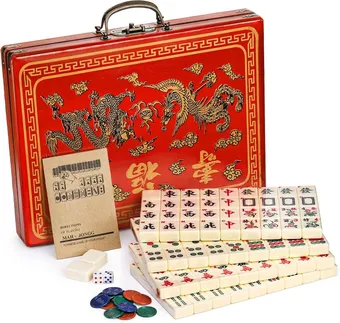
 Start HereChinese Mahjong Set (144 tiles)Standard 144-tile set for Chinese, Hong Kong, and Taiwanese play. Includes dice and wind indicator.$40–$80Check price
- For NMJL PlayAmerican Mah Jongg Set (166 tiles)166 tiles with jokers and racks for American Mah Jongg. Includes the annual NMJL card holder.$60–$120Check price
- For Riichi PlayJapanese Riichi Mahjong Set (144 tiles)Compact 144-tile set with scoring sticks and wind indicator for Japanese Riichi rules.$70–$150Check price
Prices are typical street prices and change often. As an Amazon Associate we earn from qualifying purchases.
What Mahjong feels like at the table
Mahjong is one of the world’s oldest tile games, and the tactile experience is part of the appeal. Shuffling a wall of 144 tiles, drawing and discarding with a satisfying clack, and building sets in your rack creates a ritual that card games can’t match. The game sits at the intersection of rummy, poker, and solitaire — you’re racing to complete patterns while reading what your opponents are collecting from their discards.
Player-count sweet spot
Mahjong is strictly a 4-player game. The wall, wind positions, and scoring all assume four players. Three-player variants exist (particularly in Japanese Riichi), but the full experience needs four. If you regularly play with fewer than four, Mahjong isn’t the right fit — look at 2-player board games instead.
Regional variants: which one is right for you?
Chinese (Hong Kong) is the simplest and most widely played globally. You’re collecting sets of three (pungs, kongs) or sequences (chows) in three suits plus honors. Winning hands follow a faan-point system.
American Mah Jongg uses 166 tiles (including jokers) and racks. You must match hands from the annual National Mah Jongg League card, which changes every year. The Charleston — a structured passing phase at the start — adds a unique social element.
Japanese Riichi is the most strategically complex. It uses 144 tiles, scoring sticks, and a yaku system that rewards specific hand patterns. Riichi declarations and ura-dora tiles add layers of bluffing and risk.
For detailed rules, tile names, and set recommendations for each variant, Mahjong Starter walks through everything step by step.
Buying your first set
Your first set depends on which variant you want to play. Chinese sets need 144 tiles, American sets need 166 tiles with jokers and racks, and Riichi sets need 144 tiles with scoring sticks.
Start with a mid-range set ($60–$100) in melamine or acrylic. Avoid the cheapest sets — the tiles are often too small to read comfortably. If you’re playing American Mah Jongg, budget for the annual NMJL card separately.
Learning curve and strategy
Mahjong takes about 15 minutes to teach the basics, but mastering hand-building and reading opponents takes dozens of games. The depth comes from balancing speed (completing your hand quickly) against value (building a high-scoring hand).
Unlike pure luck games, skilled players consistently outperform beginners by reading discards, pivoting when their initial plan fails, and knowing when to play defensively.
Mahjong rules FAQ
How many players can play Mahjong?
How long does Mahjong take to play?
How do you win Mahjong?
Is Mahjong hard to learn?
What age is Mahjong for?
Which Mahjong variant should I learn first?
How many players does Mahjong need?
Do I need to buy a special set to play Mahjong?
Official rules & more Mahjong resources
- Mahjong Starter ↗Beginner GuidesStep-by-step guides for Chinese, American, and Japanese Riichi rules, plus set recommendations.
Sources: mahjongstarter.com