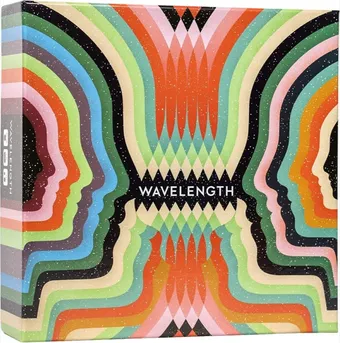
Wavelength in 60 seconds
One player (the Psychic) secretly spins a hidden target wedge along a 180-degree dial, draws a binary spectrum card (like 'Underrated ↔ Overrated' or 'Cold ↔ Hot'), and gives a single clue matching the exact spot on that spectrum. Their team debates and twists the red dial — then the screen slides open!
- Goal
- First team to reach 10 points wins (note the Catch-Up Rule: if your team hits the 4-point bullseye while still trailing, you immediately get a bonus turn!).
- On your turn
- 3 steps, explained with a diagram below.
- Core mechanics
- Social Guessing · Team Discussion · Party Game · Spectrum Dial
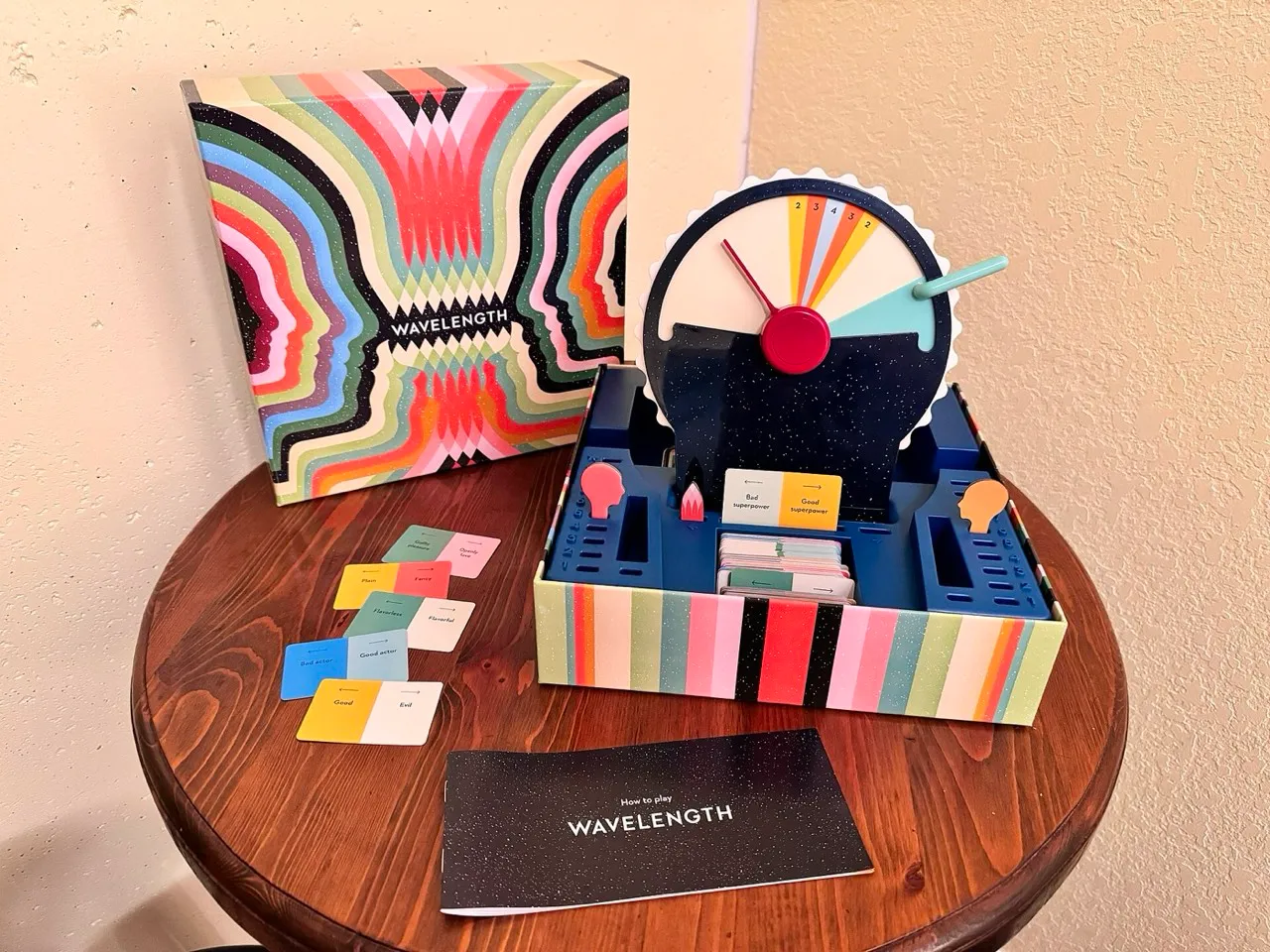
How to set up Wavelength
- Place the Wavelength dial device in the center with the red indicator needle upright and the blue screen closed.
- Split into two teams (Left Brain and Right Brain) with score markers on 0 (target: 10 points).
- Shuffle the spectrum prompt cards and pick the first Psychic.
How a turn works in Wavelength
Every turn in Wavelength follows the same 3 steps. The diagram shows how they fit together on the table.
- The Psychic closes the screen, spins the wheel blindly, peeks at the colored scoring wedge (2-3-4-3-2), and closes the screen again.
- Draw a Spectrum Card and give ONE clue on-theme (no numbers, no synonyms of the card words, and no further hints).
- Your team debates and sets the red pointer; the opposing team guesses whether the true bullseye lies to the LEFT or RIGHT for a bonus point, then open the screen to score!
How to win Wavelength
First team to reach 10 points wins (note the Catch-Up Rule: if your team hits the 4-point bullseye while still trailing, you immediately get a bonus turn!).
Watch: how to play Wavelength (video)

Video by Meeple University on YouTube. Independent creator content, shown as a reference. It is not part of our scoring.
Wavelength rules people often get wrong
- Forgetting the opposing team's Left/Right guess — if your team misses the 4-point bullseye and the opponents guessed the correct direction, they steal 1 point!
- Giving a clue that describes the dial directly ('Slightly warm') instead of naming an actual concrete example ('Lukewarm coffee' or 'Sauna').
- Skipping the Catch-Up Rule on a 4-point bullseye — it keeps games super exciting right to the wire.
Wavelength strategy tips for beginners
- Great clues name a specific, culturally shared reference ('The Mona Lisa' for Famous, 'Cilantro' for Divisive) rather than vague adjectives.
- When the target is dead-center (50%), think of something genuinely polarized or famously lukewarm rather than boring.
- As the guessing team, don't just blurt out a position — ask 'Wait, what would they have said if the target were at 100%?' to triangulate the Psychic's scale.
- Play the Cooperative 7-card mode at 2–4 players for a brisk, hilarious road-trip or date-night game.
Is Wavelength right for your group?
Wavelength is the funniest conversation starter in modern board gaming. Sliding open the plastic screen to see whether your friends nailed your '75% Guilty Pleasure' clue delivers guaranteed gasps and cheers at every party.
Best for: Big lively groups (4–12 players) who love hilarious debates like 'How hot is a burrito?' or 'Is a hot dog a sandwich?'
You'll love it if…
- The physical plastic spinning dial with sliding privacy screen creates dramatic game-show reveals
- Triggers instantly funny, revealing conversations about how your friends think
- Zero rules barrier — explain the entire game in 60 seconds
- Scales effortlessly from 2-player co-op to loud 12-person parties
Think twice if…
- Not a strategy game — purely social intuition and group banter
- The opposing team's Left/Right guess can occasionally feel slightly passive until the reveal
- Heavy groups may cycle through favorite prompt cards after 20+ sessions
Which Wavelength edition & expansions to buy
Start with the base game. Only add an expansion once Wavelength is hitting the table regularly.
 Start HereWavelength Board GameIncludes the iconic physical rotating dial device and 126 double-sided spectrum cards.$30–$38Check price
- Best Companion Party GameJust One (Great Party Companion)2019 Spiel des Jahres cooperative word party game that pairs seamlessly with Wavelength for big game nights.$22–$28Check price
Prices are typical street prices and change often. As an Amazon Associate we earn from qualifying purchases.
What Wavelength feels like at the table
Wavelength turns any living room into a hilarious psychology experiment. Within thirty seconds of drawing “Villain ↔ Hero” or “Smells Bad ↔ Smells Good,” friends are passionately debating whether Gasoline belongs at 30% or 70% — and discovering wildly surprising things about how each other’s minds work.
Player-count sweet spot
Six to ten players split into two loud teams delivers pure party magic (~35 minutes). Four players also works wonderfully, and Cooperative mode rescues 2–3 player evenings.
Buying & expansion path
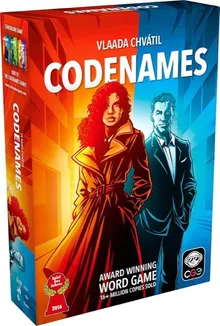
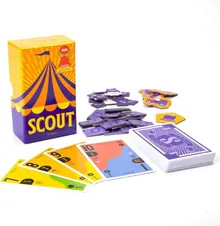
Grab Wavelength whenever you host holidays, game nights, or mixed non-gamer crowds. Pair it with Codenames and SCOUT for an unbeatable party trio, or read our best cooperative & party board games guide.
Wavelength rules FAQ
How many players can play Wavelength?
How long does Wavelength take to play?
How do you win Wavelength?
Is Wavelength hard to learn?
What age is Wavelength for?
Why is the physical Wavelength board game better than playing on a phone app?
Can Wavelength be played with 2 or 3 players?
Are the prompt cards family-friendly?
Official rules & more Wavelength resources
- Wavelength Official Site ↗Official RulesOfficial rules, Cooperative mode overview, and party tips from CMYK.
- Wavelength on BoardGameGeek ↗Database & ForumsCustom spectrum card ideas, party house rules, and group size recommendations.
Sources: wavelength.zone · boardgamegeek.com
Wavelength also appears in: Best Cooperative & Party Board Games for Any Group Size (2026)